Disaster & Emergency Insurance Claim Reporting Information
Family Disaster Planning Guide.
| DisasterAssistance.gov Disaster & Emergency Insurance Claim Reporting Information Family Disaster Planning Guide. |
The Disaster Center |
 |
 |
 |
 |
 |
 |
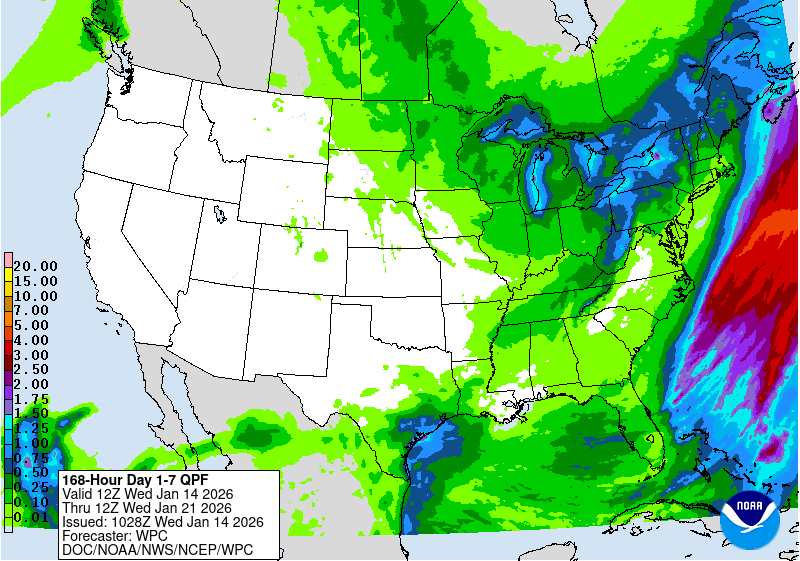
| 7-Day
Total Precipitation |
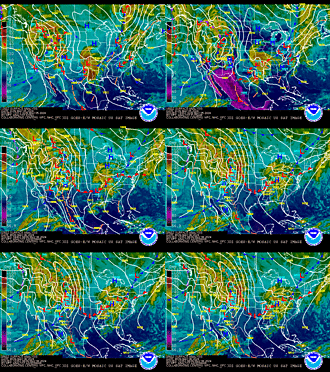
Surface Analysis Loop | Graphical Forecasts | National Forecast | National Radar | National Satellite |
 |
October 25, 2026
New Significant Incidents/ Ongoing Ops: • Flooding - New Mexico and Colorado Hazard Monitoring: • Rain / Thunderstorms – Central / Southern Plains, Florida • Mixed Precipitation – Pacific Northwest, Northern Plains • Tropical Activity ο Eastern and Central Pacific • Tropical Storm Vance • Tropical Storm Olana ο Western Pacific • Typhoon In-Fa (CAT-3) Disaster Declaration Activity: • No new declaration activity DisasterCenter.com Garden Grove Follow-Up - Auguat 16, 2026 When the Risk Crosses the Fence Line Garden Grove and the Questions Every Chemical-Plant Neighbor Should Be Asking FEMA Announces $1 Billion in Federal Funding to Help States Mitigate Impact of Disasters -- The current application window: it opened March 25, 2026 and FEMA says it runs 120 days, through July 23, 2026. The Future That Never Happened -- How the World Came Together to Save the Sky  After a disaster make your donations count -- FTC Report Fraud at ReportFraud.ftc.gov. Criminals Use Generative Artificial Intelligence to Facilitate Financial FraudFEMA Daily Situation Report -- Currentpu
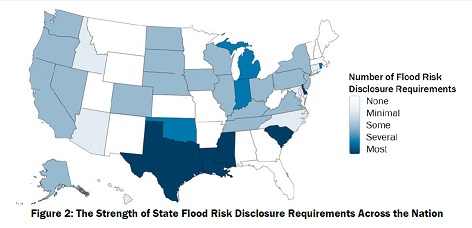
The United States is currently oscillating at a historically high frequency of destructive events. What was once a background hum of roughly 3 to 4 significant disruptions per year in the 1980s has shifted into a sustained higher harmonic — averaging 23 such events annually over the past five years, with 2023, 2024, and 2025 ranking as the three highest years on record. Factually The dominant mode in 2025 was not the one the system had been tuned to expect. For the first time since 2015, no major tropical events contributed to the signal. Instead, the energy expressed itself through a different channel — 21 severe convective events, including six major tornado outbreaks, mostly pulsing through the central United States. The system had shifted modes. The single highest-amplitude event of the year came early. The Los Angeles wildfire outbreak in January generated $61 billion in damage and 31 deaths — a sharp, concentrated spike rather than a distributed wave. It was followed by a May outbreak that demonstrated how energy can propagate across a coupled geography: 182 tornadoes moving through Missouri, Arkansas, Illinois, Indiana, Mississippi, and Alabama in just two days, generating $11 billion in damage and 43 deaths. The cumulative amplitude across all 2025 events — 276 deaths and $115 billion in total damage — reflects a system that has not returned to its prior equilibrium. Since 1980, the U.S. has absorbed 426 such events totaling over $3.1 trillion. The underlying frequency is still rising. The FBI IC3 received 535,314 complaints reporting $13.7 billion in losses last year, an average loss of $25,700 per victim. Between 2020 and 2024, a total of $50.5 billion in losses were reported to IC3. People over 60 suffered the most losses and submitted the most complaints. Victims over 60 who need assistance filing an IC3 complaint can contact the DOJ Elder Justice Hotline, 1-833-FRAUD-11 (833-372-8311). Learn more about scam prevention at fbi.gov/takeabeat. Detect immigration scams that start on social media  If someone you care about paid a scammer, here’s how to help By Jennifer Leach January 21, 2025 The Reports and Court Cases For and Against Donald Trump Printed instructions for:1040 Individual Income Tax Return 2023: includes instructions and forms for 1040/1040SR, and Schedule 1, 2 and 3, A, B, C, D, E, F, H, J, R, SE, and 8812 available on Amazon January 9, 2024 ---What goes on in the shadows: FTC action againsUt data broker sheds light on unfair and deceptive sale of consumer location data. October 12, 2023 -Your tenant background check shouldn’t have mistakes! Before you rent an apartment, read about your rights If you think a landlord or property manager violated your rights, report it to the FTC. October 26, 2023 -- UNDRR Report --2023 Global Survey on Persons with Disabilities and Disasters July 18, 2023 --Joining forces to help stop scam calls Today, the FTC and its federal and state law enforcement partners announced Operation Stop Scam Calls, the latest joint effort in the fight against illegal robocalls. Today’s announcement outlines the enforcement actions to stop multiple dishonest telemarketers, the companies that hire them, and Voice over Internet Protocol (VoIP) service providers that supply the technology for telemarketers to make millions of scam robocalls. Learn more at FTC.gov/calls You should never wire money or send money using platforms to: the Anyone claiming your account is compromised Anyone asking you to send money to yourself Anyone who claims to be from a government agency Any stranger, no matter what reason they give A telemarketer trying to sell you something Unauthorized, unverified cryptocurrency sites or salespeople November 3, 2022 - State's Flood Risk Disclosure Practices Several states have mandated multiple flood risk disclosures as part of their laws and/or disclosure forms. As illustrated in dark blue five states (Louisiana, Texas, South Carolina, Mississippi, and Delaware) have the most flood risk disclosure requirements. According to FEMA, fifteen States, including Florida, do not have any state mandated flood disclosure requirement. Hurricane Fiona: Make your donations count By Cristina Miranda Consumer Education Specialist, FTC September 23, 2022 Hurricane Fiona hit the southern part of Puerto Rico hard leaving the island in the dark, flooded, and without running water. And once again, islanders are coping and cleaning up. As with any severe weather disaster, you may be considering a charitable donation to help the people and communities in Puerto Rico that were affected. A bit of research and planning before you donate will ensure that your money goes to organizations that are helping Puerto Rico recover from this disaster and not scammers. Here’s advice on donating wisely and avoiding charity scams: Donate to charities you know and trust with a proven track record with dealing with disasters. If you get a request to donate on social media, research the organization yourself before you give. Don’t assume that charity messages posted on social media are legitimate. Check out the charity on the Better Business Bureau's (BBB) Wise Giving Alliance, Charity Navigator, Charity Watch, or Candid. If the message was from a friend, ask them if they know the organization themselves. Be cautious about giving to individuals on crowdfunding sites. If considering crowdfunding, it’s safest to give to someone you personally know and trust, and to review the platform’s policies and procedures. Keep in mind that while some crowdfunding sites take measures to vet postings for help after a disaster, others don’t. If someone wants donations in cash, by gift card, by wiring money or cryptocurrency, don’t do it. Pay by credit card, which offers more protections. When texting to donate, confirm the number with the source before you donate. The charge will show up on your mobile phone bill, but donations are not immediate. You can find this information and more at ftc.gov/charity. Looking for information to help prepare for, deal with, and recover from a natural disaster or severe weather event? Visit ftc.gov/weatheremergencies. August 21, 2022 ---Digital money movement fraud on the rise. A scammer can contact you requesting payment through a Wire Transfer --these methods allow money to be sent quickly, and the funds are often hard to trace and recover. You should never wire money or send money to: * Anyone who claims to be from a government agency * Any stranger, no matter what reason they give * A telemarketer trying to sell you something * Anyone claiming your account is compromised * Unauthorized, unverified cryptocurrency sites or salespeople * Anyone asking you to send money to yourself A kindle version of the Supreme Court Ruling in: “NY RIFLE & PISTOL Assoc. Inc v. BRUEN, of NY State Police” is available as an Amazon Kindle Book and as a paperback. August14, 2022 --FTC. FTC lawsuit reminds businesses: CAN-SPAM means CAN’T spam Can't "unsubscribe" from unwanted email? Tell the FTC: ReportFraud.ftc.gov To join the National Do Not Call Registry, go to www.donotcall.gov or call 1 (888) 382-1222. I feel more comfortable with my ignorance than their certainty FEMA
Daily
Situation Report Current
Volunteer
with Mennonite Disaster Service -- it is a volunteer
network.FEMA Daily Situation Report Archive 2026 -- FEMA Daily Situation Report Archive 2025 FEMA Daily Situation Report Archive 2024 -- FEMA Daily Situation Report Archive 2023 -- FEMA Daily Situation Report Archive 2022 -- FEMA Daily Situation Report Archive 2021 -- FEMA Daily Situation Report Archive 2020 -- FEMA Daily Situation Report Archive 2019 -- FEMA Daily Situation Report Archive 2018 -- FEMA Daily Situation Report Archive 2017 -- FEMA Daily Situation Report Archive 2016 -- FEMA Daily Situation Report Archive 2015 -- FEMA Daily Situation Report Archive 2014 -- FEMA Daily Situation Report Archive 2013 Crime Reports pages. The new pages integrate crime and imprisonment by year and States. To volunteer or donate to a National VOAD member organization FEMA has
tools to help people. It also has a poor history
of maintaining link addresses, which is why we don't
have many links to FEMA's site. Let us know is
these links stop working. Disaster
Recovery
Center (DRC) Locator -- FEMA App. Download
it for free from the App
Store or GooglePlay.--
If
you are located in the area of a declared Major Disaster
you can register online at www.DisasterAssistance.gov
or by calling 800-621-3362 or TTY 800-462-7585. If you
use 711 or Video Relay Service (VRS), call 800-621-3362.
Operators are multilingual and calls are answered seven
days a week from 7 a.m. to 10 p.m. CDT.
We've been working on updating the State disaster pages. Here they are, a work in progress: Alabama -- Alaska -- Arizona -- Arkansas -- California -- Colorado -- Connecticut -- Delaware -- Florida -- Georgia -- Hawaii -- Idaho -- Illinois -- Indiana -- Iowa -- Kansas -- Kentucky -- Louisiana -- Maine -- Maryland -- Massachusetts -- Michigan -- Minnesota -- Mississippi -- Missouri -- Montana -- Nebraska -- Nevada -- New Hampshire -- New Jersey -- New Mexico -- New York -- North Carolina -- North Dakota -- Ohio -- Oklahoma -- Oregon -- Pennsylvania -- Rhode Island -- South Carolina -- South Dakota -- Tennessee -- Texas -- Utah -- Vermont -- Virginia -- Washington -- West Virginia -- Wisconsin -- Wyoming If you have any suggestions about how it can be improved, please send an email to host@disastercenter.com Ready Rating: A FREE Service from the American Red Cross The Red Cross, Salvation Army and other volunteer organizations move resources into position so as to be able to respond to disasters. Please consider a donation to the Red Cross You can text REDCROSS to 90999 to make a $10 donation or call 1-800 RED CROSS There are several ways you can donate to the Salvation Army . By phone: Call 1-800-SAL-ARMY By text: Text “GIVE” to 80888. Also, consider volunteering or donating with Disaster Relief Agencies and Nongovernment Organizations. Red Cross -- After a disaster, letting your family and friends know that you are safe and well can bring your loved ones great peace of mind. This website is designed to help make that communication easier. FBI's "Tips on Avoiding Fraudulent Charitable Contribution Schemes" If you want to suggest a link, please post to host@disastercenter.com The people affected will not lack clothing for long and more will be donated than will ever be used. It will end up in the local landfill, because there is no place to store it. If you are going to collect clothing have a garage sale with the proceeds going to the victims. Be responsible, if you collect money get proof that it was donated and make evidence available to those who gave. Consider volunteering or donating with Disaster Relief Agencies and Nongovernment Organizations. WHO's CRED is reporting that in 2010 a total of 385 natural disasters killed more than 297,000 people worldwide, affected over 217.0 million others and caused US$ 123.9 billion of economic damages. Annual Disaster Statistical Review 2010: (PDF 4.2 MB) The Numbers and Trends. Brussels: CRED; 2011-Guha-Sapir D, Vos F, Below R, with Ponserre S. There is only one weather authority in the United States, and that's the National Weather Service For emergency information consult with your local NWS office or your local emergency management agency. If you want to suggest a link, please post to host@disastercenter.com The Disaster Center
supports the UN's International Strategy for Disaster
Reduction. "One
million
safe
schools and hospitals campaign" [PDF 3.28
MB] guidance
note [PDF 2.04 MB]
Schools and hospitals are a great place to start building a world wide disaster mitigation movement. How to get a free credit report:
Online: www.annualcreditreport.com Call toll free: (877) 322-8228 Write: Annual Credit Report Request Service, P.O. Box 105281, Atlanta, GA, 30348-5281 The Disaster Center
hosts a Talking
About
Disaster:
Guide for Standard Messages
The CDC has recently come out with its Social Media: Preparedness 101: Zombie Apocalypse Guide and announced a forthcoming video contest. The idea that all these efforts are concerned with is that you and your family be prepared for disasters. In our estimation the most important disaster readiness tool is a common contact person outside of the disaster area. Someone who, if conditions are so bad that household members can't go home, that you might move in with. After disasters most people do not stay in shelters. They are sheltered by relatives and friends. So what we are saying is that the greatest tool after a disaster is a friend; get one; be one. The Red Cross has created a teaching guide -- Children in disasters- Games and guidelines to engage youth in risk reduction A new National Science
Foundation study has found that: Drought
may
threaten
much of globe within decades - NSF
A
study released by researchers at Iowa State
University calculated costs of five major crimes, and
found that each murder generated societal costs of
$17.25 million
States: 10
Leading
Causes
of DeathVital Records: Locate your States' sources for Birth, Death, Marriage, and Divorce Records
National Radar Mosaic
Sectors
CBS
News:
Is
Extreme Weather a Result of Global Warming?
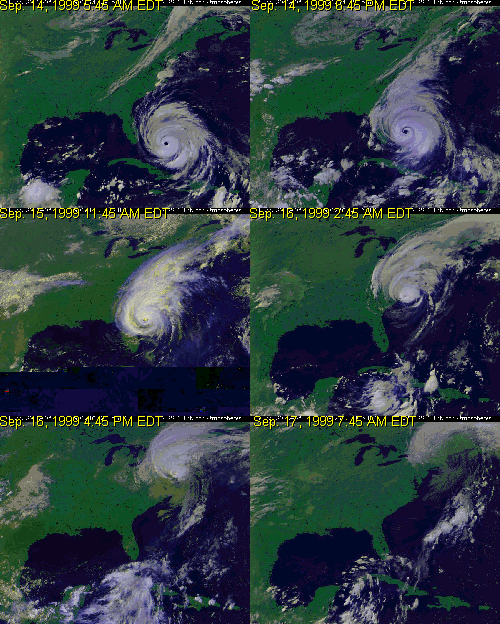
NASA Earth Observery Image of the Day: Arctic Oscillation Chills North America, Warms Arctic The National Terrorism Advisory System (NTAS) has replaced the color codes of the Homeland Security Advisory System (HSAS). The new alert system is currently active, active alerts are also available on Twitter and Facebook Established 14 years ago, the Disaster Center site has gone through a number of evolutions. A big part of this work has provided coverage for disasters affecting the United States. Big stories were Hurricane Dennis, Rita, Katrina, Wilma, Floyd, Mitch, Bret and many others. One of the most linked to areas on the web site has been our graphics. The most popular of these Hurricane Floyd as it approached the US coast. Current and Historic Atlantic Tropical Storms and Hurricanes Our work of mitigating disasters involves the preparation for them, responding to them, and recovering from them. In an ideal world we would be working on ways to mitigate risk SBA
Disaster
Recovery
Loans 1-800-659-2955 --
SBA
makes
loans to home owners and business after Major
disasters
HUD may provide disaster recovery assistance. Here’s the distinction
I’d keep front and center:
Reality (territory): what happens. You touch it through closures and replayable counts. Math (map): a compact way to predict parts of that reality. Useful, but never the thing itself. Box tricks: controlled set-ups to learn something without confusing the set-up for the world. A tiny manifesto you can pin to keep honest: Sovereignty of facts: Base closures rule. Models advise; they don’t overrule. Map ≠ Territory: Every abstract claim must point to its test path and TTL—or it expires. Plain → Formal → Check: Say it plainly, formalize it briefly, verify it against facts. Safety Stack always on: Unclear? High burden? Abstain. Redesign the room. Explain like a neighbor: If we can’t say it in human language, we don’t pretend we know it. Physics doesn’t require denying reality; it works best when it respects it. |
|

WHO -- Disease Outbreak News UN-SPIDER Knowledge Portal
 Aerosol Optical Depth
|
 Aerosol Size
|
 Carbon Monoxide
|
 Land Surface Temperature
|
 Chlorophyll
|
 Cloud Fraction
|
 Fire
|
 Net Radiation
|
 Land Surface Temp. Anomaly
|
 Sea Surface Temperature
|
 Net Primary Productivity
|
 Sea Surface Temp. Anomaly
|
 Snow Cover
|
 Water Vapor
|
 Total Rainfall
|
 Vegetation
|
Here are some tips you can use to avoid becoming a victim of cyber fraud:
If you have received a suspicious e-mail, file a complaint with the Internet Crime Complaint Center: www.ic3.gov.
For more information on e-scams, visit the FBI’s E-Scams and Warnings webpage: www.fbi.gov/scams-safety/e-scams